The Space Between: How Japan's Ancient Principle of Ma Is Quietly Transforming the Way Overscheduled Americans Understand Rest, Silence, and Presence
The Space Between: How Japan's Ancient Principle of Ma Is Quietly Transforming the Way Overscheduled Americans Understand Rest, Silence, and Presence
There is a particular kind of discomfort that most Americans know well. It arrives in the pause after someone finishes speaking, in the unscheduled Sunday afternoon, in the moment before a reply is given. We reach instinctively for our phones, our calendars, our next obligation. Stillness, in the American cultural imagination, has long carried the faint scent of failure — as though the person who is not visibly busy is not sufficiently alive.
Japan has a different arrangement with silence.
The concept of ma (間) — pronounced approximately as "mah" — resists a clean English translation, which is itself part of its lesson. It is most commonly rendered as "negative space" or "pause," but those phrases flatten something far more dimensional. Ma refers to the conscious, cultivated gap between things: between sounds, between objects, between words, between moments. It is not emptiness waiting to be filled. It is emptiness recognized as complete in itself.
For a culture as thoroughly scheduled as contemporary American life, this is not a minor philosophical adjustment. It is a structural rethinking of what time is actually for.
A Principle Woven Into Japanese Aesthetics
Ma does not belong to a single domain. It operates across Japanese art, architecture, music, theater, conversation, and garden design with a consistency that suggests something deeper than aesthetic preference — a worldview in which what is absent carries as much meaning as what is present.
In traditional Japanese architecture, rooms are frequently designed around open, unadorned space. The tokonoma — a recessed alcove found in formal rooms — typically holds a single hanging scroll and perhaps one carefully chosen object. Nothing else. Where an American interior designer might see an opportunity to add, the Japanese aesthetic sees an opportunity to let the emptiness speak. The objects gain dignity precisely because they are not competing for attention.
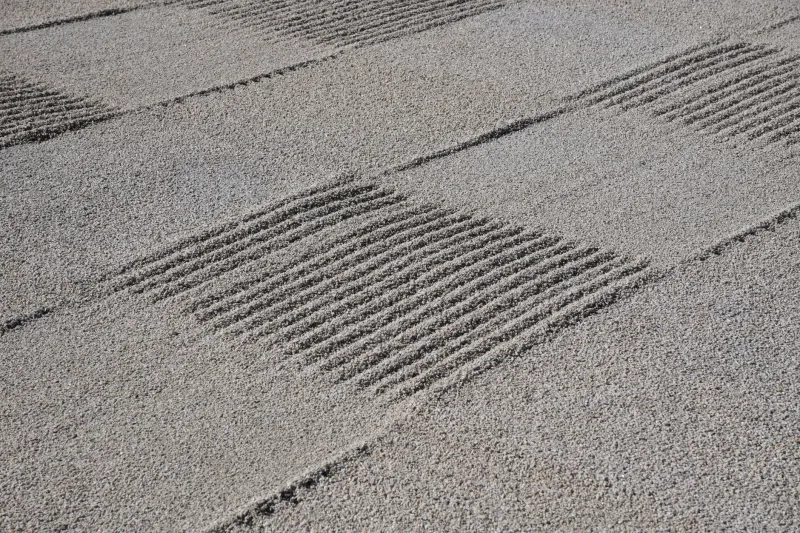
In Japanese garden design, the principle becomes almost theatrical. The dry stone gardens of Kyoto — most famously at Ryoanji Temple — arrange rocks within expanses of raked gravel that represent, variously, water, clouds, or simply the void. Visitors are not meant to walk through these gardens. They are meant to sit with them, to allow the eye to move slowly, to notice that the space between the stones is as carefully considered as the stones themselves. The American instinct to fill, to plant, to landscape every available inch finds no purchase here.
In music, ma appears as the interval of silence between notes — the rest that is not a break from music but a constituent part of it. Japanese traditional forms, from the ceremonial music of gagaku to the spare compositions performed on the shakuhachi flute, treat silence not as the absence of sound but as sound's necessary counterpart. Western musical training acknowledges rests, certainly, but the cultural weight placed upon them differs markedly. In Japan, the pause is not what happens when the music stops. It is where the music breathes.
Ma in Conversation and Human Connection
Perhaps the most immediately applicable dimension of ma for American readers is its role in interpersonal communication. In Japanese conversational culture, silence between speakers is not an emergency to be resolved. It is a sign of consideration — evidence that the listener is genuinely processing what was said before responding. The speed of a reply, in this context, is not a measure of engagement. It may, in fact, signal the opposite: that a person is responding from reflex rather than reflection.
This stands in sharp contrast to the rhythms of American professional and social conversation, where silence is frequently interpreted as awkwardness, disagreement, or disengagement. Meeting culture in the United States tends to reward the person who speaks first, speaks often, and fills the available air. The result, not infrequently, is a great deal of noise and a relative scarcity of genuine listening.
The discipline of ma asks something genuinely difficult of people trained in that environment: to resist the impulse to fill. To allow a pause to exist without immediately dismantling it. To trust that the space between words is not a problem requiring a solution.
Why This Matters Now, in America
The timing of ma's growing visibility in American wellness and design conversations is not coincidental. Rates of anxiety, burnout, and what researchers have begun calling "decision fatigue" have climbed steadily alongside the expansion of digital connectivity. The average American adult now makes an estimated 35,000 decisions per day. Notifications arrive in fractions of seconds. The concept of being "off" — genuinely unavailable, genuinely still — has become so foreign to many working adults that they must schedule it, justify it, and often feel guilty about it even as they attempt it.
Ma does not offer a productivity hack. It does not promise that rest will make you more efficient, though it may. It offers something more foundational: a reframing of what rest is. In the ma tradition, stillness is not the recovery period between productive intervals. It is itself a form of engagement — with one's surroundings, one's inner state, one's relationships. The pause is not preparation for something more important. It is the thing itself.
Practicing Ma Without Traveling to Kyoto
Adopting ma as a genuine practice does not require a pilgrimage or a wholesale reinvention of daily life. It begins, as most meaningful shifts do, with attention.
Consider, first, your physical environment. A single surface cleared of objects. A corner of a room left deliberately undecorated. The visual rest this creates is not negligible — it trains the eye, and by extension the mind, to recognize that space itself has value.
Consider, second, your conversational habits. Before responding to a colleague, a partner, or a friend, allow a beat of genuine silence. Not the performed pause of someone choosing their words strategically, but the authentic pause of someone actually listening. Notice how this changes the texture of the exchange.
Consider, third, what you do with unscheduled time. Not how you optimize it or how you justify it, but whether you can allow it to exist without immediately converting it into something useful. A walk without a destination. A morning without an agenda. These are not indulgences in the ma tradition. They are disciplines.
The Reward of the Empty Space
There is a phrase sometimes associated with Japanese aesthetics: yohaku no bi — the beauty of blank space. It captures something that ma gestures toward but does not exhaust: the idea that what is left out of a composition, a conversation, or a day is not a deficit but a deliberate and dignified choice.
American culture has produced extraordinary things through its commitment to industry, ambition, and forward motion. But the cost of that commitment — measured in anxiety, exhaustion, and a persistent inability to be present in any given moment — has become difficult to ignore.
Japan's gift, in this instance, is not a product or a technique. It is a permission structure: the cultural authorization to stop, to be still, to allow the pause its full measure of meaning. Ma does not ask you to do nothing. It asks you to understand, perhaps for the first time, that doing nothing is itself a form of doing something — something ancient, considered, and quietly profound.