Every Degree Counts: The Hidden Language of the Japanese Bow and What It Reveals About a Culture That Takes Respect Seriously
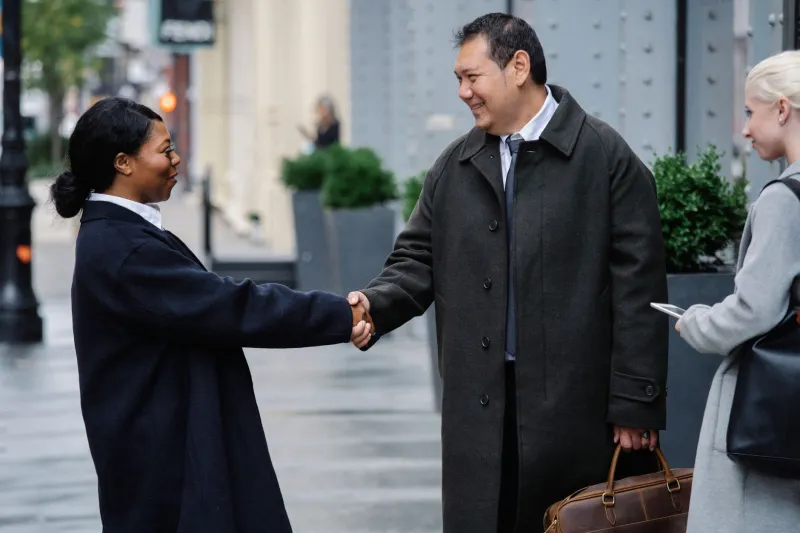
There is a moment familiar to nearly every American who has traveled to Japan or hosted a Japanese colleague in a professional setting — the moment when both parties reach for a handshake and a bow simultaneously, resulting in an awkward collision of intentions. One person lunges forward with an outstretched hand. The other inclines at the waist. Somehow, foreheads nearly meet. Laughter follows, and the moment dissolves into goodwill.
But beneath that comedy of cross-cultural manners lies something worth examining carefully. The Japanese party in that exchange was not simply performing a quaint custom. They were engaging in a centuries-old discipline — one that communicates social position, emotional sincerity, and moral awareness all at once, without a single spoken word.
That discipline has a name: ojigi. And it is considerably more sophisticated than most Westerners have been led to believe.
A Gesture With Its Own Grammar
To describe ojigi merely as "bowing" is a bit like describing a symphony as "music with instruments." The form is accurate. The depth is missing.
In Japanese social life, bowing operates according to an intricate internal grammar. The angle of inclination is not arbitrary — it is calibrated. A shallow bow of roughly fifteen degrees serves as a casual acknowledgment between acquaintances or a passing nod of thanks in an everyday transaction. At thirty degrees, the gesture becomes more deliberate: a respectful greeting to a superior, a client, or an elder. When the bow deepens to forty-five degrees or beyond, the message shifts entirely. This is the bow of sincere apology, of profound gratitude, or of reverence in a sacred context.
Duration matters just as much as angle. A bow held for three seconds communicates something meaningfully different from one held for ten. And the question of who rises first carries its own social weight — in a hierarchical exchange, the person of lower status traditionally remains inclined longer, a physical enactment of deference that requires both awareness and restraint.
Then there is the matter of eye contact. In American culture, holding another person's gaze during a greeting is generally read as confidence and openness. In the context of a formal Japanese bow, particularly one directed toward a senior figure, dropping the gaze is not avoidance — it is a mark of appropriate humility.
Hierarchy Made Visible
Japanese society has long organized itself around a concept known as tate shakai — a vertically structured society in which relationships are understood through the lens of relative position. Age, professional rank, tenure, and social context all determine where one stands in relation to another. Ojigi is, in many ways, the physical vocabulary of that structure.
This is not, as some Western observers have assumed, a system designed to diminish individuals. Cultural anthropologists who have studied Japanese social behavior at length argue the opposite: that a codified system of greeting actually clarifies relationships, reduces social ambiguity, and creates a shared framework within which everyone knows how to behave. The rules, paradoxically, can be liberating. When the form is established, energy is freed for genuine connection.
In the workplace, ojigi follows the contours of organizational hierarchy with remarkable precision. A new employee bowing to a department head will incline more deeply and hold the position longer than a seasoned manager greeting a peer. In customer service settings — and Japan's service culture is globally renowned for its rigor — staff are often trained to bow at a consistent thirty-degree angle as a sign of professional respect toward patrons. Some retailers and hospitality establishments continue bowing even after a customer has departed, maintaining the gesture until the person is entirely out of sight. The bow, in these moments, is not performance. It is principle.
The Discipline of Seeing Another Person
What makes ojigi philosophically compelling, rather than merely socially interesting, is what it demands of the person performing it. To bow correctly — not mechanically, but with genuine intention — requires that one first recognize the person standing before them. Their age. Their role. The nature of the moment. The emotional register of the exchange.
In that sense, a well-executed bow is an act of attention. It requires that you see the other person before you respond to them.
This stands in notable contrast to many contemporary American greeting customs, which have grown increasingly informal and, at times, inconsistent. The handshake — once the standard of professional exchange — has become complicated by pandemic-era hesitancy and generational preference. Hugging has migrated into contexts where it once would have seemed intrusive. The fist bump, the casual wave, the two-finger salute: American greetings have become a negotiation rather than a shared understanding. There is warmth in that flexibility, certainly. But there is also ambiguity, and ambiguity can leave people uncertain about where they stand.
Behavioral researchers studying nonverbal communication have noted that physical greetings serve a function well beyond mere acknowledgment — they establish the emotional tone of an interaction, signal the degree of formality expected, and communicate how much the other person is valued. By that measure, a greeting ritual that has been carefully considered and consistently practiced carries more relational information than one assembled on the spot.
What Children Learn From the Bow
In Japan, the practice of ojigi begins early. Children are introduced to bowing in school settings and at home, often before they have the conceptual vocabulary to articulate why they are doing it. The physical habit is established first; the understanding follows.
This sequencing is not incidental. There is a long tradition in Japanese education and moral philosophy — rooted in both Confucian influence and indigenous cultural values — that holds that correct behavior, practiced consistently, eventually becomes genuine character. The child who bows before entering a dojo, who thanks a teacher with a deliberate incline, who greets an elder with appropriate deference, is not merely following rules. They are, over time, developing an orientation toward others that becomes instinctive.
For American parents and educators who have grown increasingly interested in social-emotional learning and empathy development, there is something worth considering here. Ritual, when it is meaningful rather than empty, can serve as a vehicle for values. The form teaches the feeling, not the other way around.
A Mirror Held Up to American Customs
To study ojigi is, inevitably, to reflect on what American greetings communicate — and what they might inadvertently conceal. A culture that prizes informality and egalitarianism tends to flatten the distinctions that bowing makes visible. There is democratic appeal in that. But it can also obscure genuine relationships of gratitude, respect, and care.
This is not an argument that Americans should begin bowing to one another — cultural practices do not transplant without context, and ojigi belongs to a social fabric that extends far beyond the gesture itself. But it is an invitation to ask a question that the practice makes unavoidable: when you greet someone, what are you actually communicating about how much you see them?
In Japan, the answer to that question is encoded in the spine. Every degree counts. Every second held is a word spoken without language. And the person receiving the bow knows exactly what has been said.
There is a discipline in that — and perhaps, for those willing to look closely, a lesson that transcends any single culture's customs.