Two Hands, One Moment: The Japanese Ceremony of Meishi Koukan and What It Reveals About the True Cost of a Rushed Introduction
Picture the last professional event you attended. Perhaps a conference in Chicago, a chamber of commerce mixer in Atlanta, or a startup pitch night somewhere in Austin. Cards were produced from pockets, sometimes crumpled, occasionally forgotten altogether in favor of a LinkedIn QR code flashed from a phone screen. Names were spoken once and absorbed by no one. The encounter lasted perhaps forty-five seconds before both parties moved on, already scanning the room for the next connection.
Now consider a different scene entirely.
In Japan, when two professionals meet for the first time, the business card — known as meishi — is not an afterthought. It is the opening statement of a relationship. The act of exchanging it, called meishi koukan, is governed by a set of deeply ingrained conventions that transform a simple gesture into something closer to a ceremony. And in observing those conventions, something remarkable happens: both parties are required, however briefly, to treat each other as fully human.
What a Card Represents in Japanese Professional Culture
To understand why meishi koukan carries such weight, one must first appreciate what a business card signifies in Japan. It is not merely a rectangle of printed paper containing a phone number and a job title. In Japanese professional culture, the meishi is understood as an extension of the person who carries it — a physical representation of their professional identity, their organizational standing, and by extension, their personal dignity.
This is not a metaphor lightly applied. It is a principle that shapes behavior in observable, specific ways. Cards are stored in dedicated card cases, often made from leather or lacquered wood, rather than loose in a wallet or the bottom of a bag. They are printed with care, sometimes on heavier stock, occasionally with subtle design choices that communicate something about the individual or their company. Arriving at a meeting without meishi is considered not merely inconvenient but genuinely discourteous — a signal that you did not consider the encounter worth preparing for.
When Americans hear this, the reaction is often a mixture of amusement and mild discomfort. We have largely decided that the business card is a relic, a paper artifact being phased out by digital convenience. In doing so, we may have discarded something more significant than we realized.
The Choreography of the Exchange
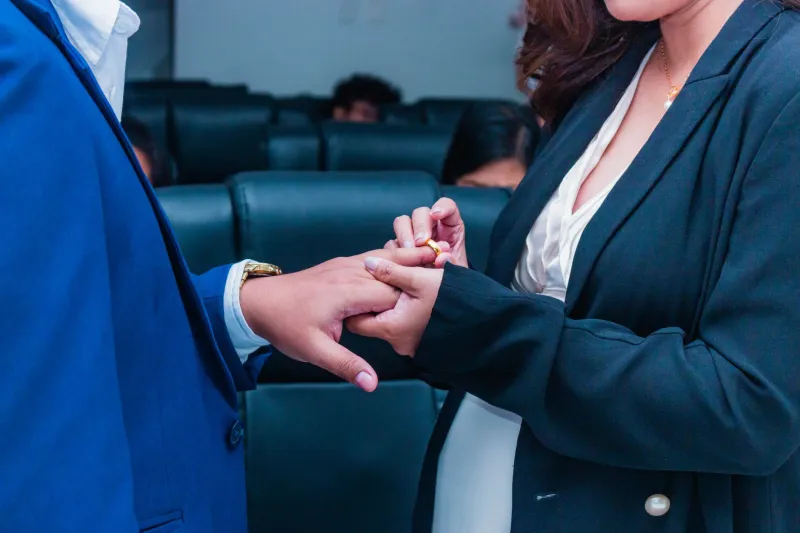
Meishi koukan follows a sequence that, once understood, reveals itself as quietly elegant. When two professionals meet, cards are presented with both hands, the text oriented so that the recipient can read it immediately without having to rotate the card. The card is offered with a slight bow and, in many cases, a verbal acknowledgment of the introduction. It is received, also with both hands, and then — and this is the detail that most surprises Western observers — it is actually read.
Not glanced at. Read. The recipient takes a moment to study the name, the title, the company, sometimes the address. This pause is not performative. It is understood as a mark of respect, an acknowledgment that the information on the card — and therefore the person who handed it over — merits genuine attention.
During a meeting, received cards are typically arranged on the table in front of the recipient, positioned according to the seating hierarchy of those present. Writing on a card, bending it, or sliding it carelessly into a pocket while the other person is still in view are all considered serious breaches of etiquette. After the meeting, cards are transferred to a dedicated holder and preserved.
The entire ritual, from presentation to careful storage, communicates a single consistent message: you matter enough for me to pay attention.
Why This Feels So Foreign to American Professionals
American networking culture has long prized efficiency and informality as virtues. The ability to work a room quickly, to make an impression in thirty seconds, to follow up via a LinkedIn connection request before you have even left the building — these are skills actively taught in business schools and celebrated in professional development literature. Speed is framed as confidence. Brevity is framed as respect for the other person's time.
But there is a cost embedded in that philosophy that rarely gets examined. When every introduction is optimized for speed, none of them are optimized for depth. The person across from you becomes a potential contact rather than a human being deserving of focused attention. The exchange becomes a transaction rather than the beginning of a relationship.
Meishi koukan operates from a fundamentally different premise: that the quality of a first impression is determined not by how quickly it is executed but by how fully it is inhabited. The ritual slows things down on purpose. It creates a structure that demands presence from both parties, even if only for a minute or two.
The Philosophy Beneath the Protocol
Japanese professional culture did not develop these conventions arbitrarily. They reflect broader values that run throughout many of the traditions explored on this site — a commitment to ma, the meaningful pause; to omotenashi, the anticipation of another's needs; and to the idea that how you do something is inseparable from what you are communicating by doing it at all.
In the context of meishi koukan, the protocol itself is the message. By presenting your card with both hands, you signal that you are not distracted, not in a hurry, not already thinking about the next conversation. By pausing to read what you have been given, you signal that you consider the other person's identity worth your full attention. By handling the card with care throughout the meeting, you signal that the relationship, however new, is something you intend to treat with respect.
None of this requires a lengthy interaction. The ritual can be completed in under two minutes. But those two minutes are qualitatively different from the forty-five-second card-toss of a typical American mixer. They are minutes in which both parties are genuinely present with each other.
What American Professionals Might Reconsider
This is not an argument that Americans should wholesale adopt Japanese business card etiquette, though doing so in contexts where Japanese colleagues or clients are present is a straightforward act of cultural respect that pays dividends. The deeper invitation is to examine what we have quietly decided does not matter in our professional introductions, and whether that decision has been made consciously or simply by default.
The business card itself may or may not survive the digital transition. But the instinct it represents in Japanese culture — the instinct to mark a first meeting as significant, to slow down enough to register the person in front of you, to treat the beginning of a professional relationship as something worth honoring — that instinct does not become obsolete because we have better technology for storing contact information.
If anything, in an era when a LinkedIn connection can be established without ever making eye contact, the deliberate pause of meishi koukan looks less like an anachronism and more like a corrective.
Arriving Prepared, Departing Remembered
There is a practical dimension worth noting as well. Professionals who have worked extensively with Japanese companies report that the care taken during meishi koukan sets a tone that carries through an entire business relationship. It signals seriousness, preparation, and cultural awareness. It communicates, before a single word of business has been spoken, that you understand the difference between a transaction and a relationship.
In a globalized economy where American companies increasingly seek partnerships across the Pacific, understanding and honoring this ritual is not merely a gesture of goodwill. It is a demonstration of competence.
But beyond the strategic, there is something simpler and more human at the center of meishi koukan. It asks each participant to be fully present for the moment of meeting another person. In a professional culture that has largely decided such moments are too small to deserve our full attention, that ask feels, quietly, radical.
Japan has known for a very long time that how you greet someone tells them everything about how you intend to treat them. The business card is just the medium. The message is the care you bring to the exchange.