Before You Cross the Threshold: What Japan's Genkan Ritual Reveals About the Invisible Line Between the World and the Home
A Step Down That Means Something
In nearly every Japanese home — whether a centuries-old farmhouse in rural Gifu or a compact apartment in central Tokyo — there exists a small architectural feature that most Western visitors notice immediately and understand only partially. It is called the genkan, and it sits just inside the front door: a sunken entryway, typically paved in stone, tile, or concrete, that sits a few inches below the level of the main floor. You step into it when you arrive. You step up out of it, in your socks or offered slippers, when you are finally welcomed in.
That small elevation — a few centimeters of stone — carries the weight of an entire cultural philosophy.
The genkan is not simply a practical mat for dirty footwear. It is a liminal space, a deliberately designed zone of transition where the outside world is formally left behind. Shoes come off here. Street dust, noise, and the accumulated weight of public life stay here. The act of crossing upward from the genkan into the home is, in the Japanese cultural imagination, a crossing from the impure to the pure — from the world's disorder into a space that deserves something better.
The Architecture of Respect
To understand the genkan, it helps to understand how Japanese culture has long organized space into layered categories of purity. Shinto, Japan's indigenous spiritual tradition, holds that certain spaces carry a sacred quality that must be protected from contamination — not merely physical contamination, but spiritual and symbolic impurity as well. Temples and shrines have their own entry rituals: the torii gate that marks the boundary between ordinary and sacred ground, the temizuya water basin where hands and mouth are rinsed before approaching the divine.
The genkan is, in a very real sense, the domestic version of this logic. The home is a sanctuary. The street is not. And the space between them demands a conscious, embodied act of transition.
Shoes, in this framework, are not merely dirty — though they are certainly that. They are symbols of the outside, carriers of everything the street represents: commerce, strangers, noise, uncertainty. Leaving them behind in the genkan is an act of respect for the home and for the people who live in it. It says, quietly and without fanfare: I understand that I am entering something different now. I am adjusting myself accordingly.
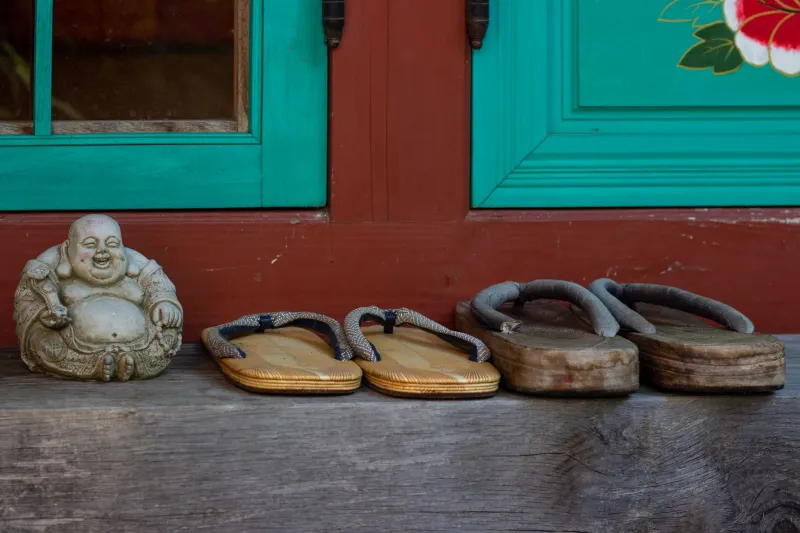
The ritual extends further still. In many traditional households, a host will have already placed a pair of guest slippers near the step-up point — clean, often never worn by anyone else, arranged with their toes pointing outward toward the arriving guest. This small gesture is deliberate. It tells the visitor: your comfort has been anticipated. You were expected. You are welcome here. The slippers are not an afterthought. They are an offering.
What American Entryways Say by Saying Nothing
Consider, by contrast, the typical American front door experience. A guest rings the bell. The door opens. They walk in — shoes still on, often without a second thought — directly onto carpet, hardwood, or tile that connects seamlessly to the rest of the living space. There is no pause, no threshold ritual, no physical marker that distinguishes the world they just came from and the home they have just entered.
This is not a moral failing. It is a cultural default, and like most cultural defaults, it carries its own implicit message. The American home, in this arrangement, extends an easy, frictionless welcome. Come as you are. No adjustment necessary. The outside world and the inside world are, architecturally and symbolically, continuous.
There is a warmth in that — an egalitarianism, even. But there is also a cost. When no transition is required, no transition is made. Guests arrive carrying everything the street gave them: the distraction, the pace, the noise. The home absorbs it without ceremony. And the domestic space — whatever private meaning it holds for the people who live there — receives no formal acknowledgment of its difference from everything outside.
The genkan asks something small of the people who enter. That small ask, it turns out, changes everything.
The Discipline Hidden in a Simple Gesture
Anthropologists who study Japanese domestic culture frequently note that the genkan functions as more than a cleaning station. It is a moment of psychological preparation. The act of bending down, removing one's shoes, placing them neatly to the side (heels aligned, toes pointing outward in some households, a sign of consideration so that one's shoes are easy to step back into upon leaving) — all of this creates a brief, necessary interruption between arrival and entry.
That interruption matters. It gives the guest a moment to shift gears, to recognize that they are no longer in transit but in someone's home. It gives the host a moment to complete the welcome. The genkan, in this sense, is not a delay. It is a gift — a small pocket of time in which both parties acknowledge, without words, that what is about to happen has a different quality than whatever came before.
For Americans accustomed to moving at full speed from the parking lot to the living room couch, this enforced pause can feel awkward at first. Visitors to Japan who experience the genkan for the first time often report a mild self-consciousness — a sudden awareness of their own shoes, their own bodies, their own presence in someone else's space. That self-consciousness, the Japanese tradition would suggest, is precisely the point.
Reexamining the American Threshold
None of this is to suggest that American homes need to be immediately retrofitted with sunken entryways and guest slippers — though a surprising number of American households influenced by Japanese design have done exactly that. The deeper invitation here is one of reflection.
What does your front door ask of the people who cross it? What does the absence of any threshold ritual communicate about how you regard your own domestic space — and how much you ask of the people you welcome into it? Is the frictionless American entry a sign of genuine openness, or is it, in some quieter way, a sign that we have stopped thinking about our homes as spaces worthy of deliberate transition?
The genkan does not demand grandeur. It asks only for a moment. A pause. A small act of physical acknowledgment that one world has been left behind and another, more private one, is being entered.
In Japan, that moment is built into the architecture. For the rest of us, it may simply require the willingness to stop — just for a breath — before we step inside.
A Threshold Worth Honoring
The traditions explored on these pages share a common thread: they ask us to slow down long enough to recognize what we are doing and why. The genkan is, in many ways, the most literal expression of that invitation. It is a line drawn in stone, a step up from the ordinary, a quiet insistence that the home deserves a different kind of attention than the world outside.
Japan has been drawing that line for centuries. The question it leaves for the rest of us is simple, and not entirely comfortable: where is yours?