Serving Without Being Asked: How Japan's Philosophy of Omotenashi Is Quietly Reshaping American Hospitality
Serving Without Being Asked: How Japan's Philosophy of Omotenashi Is Quietly Reshaping American Hospitality
There is a moment that many travelers to Japan describe with striking consistency. They have not yet reached for the menu before a server appears with a warm oshibori towel. They have not yet looked confused before a staff member gently guides them in the right direction. No request has been made, no complaint lodged — and yet, every need has already been met. This is not coincidence. This is omotenashi.
For American visitors accustomed to flagging down servers or navigating automated customer service menus, the experience can feel almost disorienting in the best possible way. But omotenashi is far more than polished manners or efficient staff training. It is a centuries-old cultural philosophy, and its roots run surprisingly deep.
From the Tea Room to the Modern Dining Table
The word omotenashi (おもてなし) is most commonly translated as "wholehearted hospitality," though linguists and cultural scholars note that the phrase carries layers that resist simple translation. One interpretation breaks it into omote (surface or face) and nashi (without), suggesting a kind of service rendered without pretense — genuine, unperformed, and unconditional.
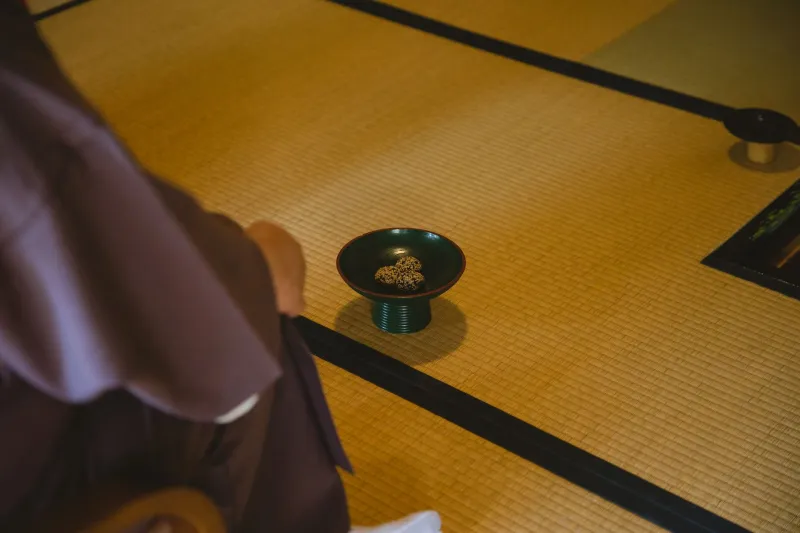
Its most frequently cited origin lies in the Japanese tea ceremony, or chado, which flourished under the influence of the 16th-century tea master Sen no Rikyu. The philosophy he articulated — ichi-go ichi-e, meaning "one time, one meeting" — held that each encounter between host and guest was singular and unrepeatable. The host's entire purpose was to make that single moment as meaningful as possible, attending to every sensory detail of the space, the tea, and the guest's comfort, without expectation of recognition or reward.
 Photo: Sen no Rikyu, via sen.news
Samurai culture reinforced this ethic. A warrior who hosted a guest was expected to anticipate needs before they were voiced, interpreting hospitality as a form of discipline and honor rather than a commercial transaction. Over centuries, this attitude permeated Japanese inn culture, known as ryokan, where proprietors called okami studied their guests' preferences and adjusted every element of their stay accordingly — sometimes based on nothing more than careful observation.
What Makes Omotenashi Different From Good Service
To understand why omotenashi resonates so differently from conventional Western hospitality, it helps to examine what American service culture typically values. In the United States, customer service is largely transactional: a guest makes a request, a staff member fulfills it, and the quality of the interaction is measured by speed, accuracy, and friendliness. This model is efficient and, at its best, genuinely warm. But it is fundamentally reactive.
Omotenashi inverts this dynamic entirely. The host does not wait to be asked. The host studies, anticipates, and acts — often invisibly. In a traditional Japanese inn, guests might find their yukata robe folded precisely to their body size, their evening bath drawn at their preferred temperature, or a small seasonal sweet placed beside their bed without explanation. These gestures are not designed to impress. They are designed to make the guest feel, on some wordless level, that they have been truly seen.
This distinction carries philosophical weight. American hospitality, shaped in part by a service economy that rewards visible effort, often makes guests aware of the service being rendered. Omotenashi, by contrast, aims for a kind of seamlessness — the ideal is that the guest never notices the labor behind the care.
American Businesses Taking Notice
In recent years, a growing number of American establishments have begun incorporating omotenashi principles into their operations, sometimes explicitly and sometimes organically.
The Peninsula Chicago, long regarded as one of the Midwest's premier luxury hotels, has introduced staff training programs that emphasize anticipatory service — learning repeat guests' preferences before arrival and personalizing experiences without being prompted. Several Michelin-starred restaurants in New York and San Francisco, including establishments helmed by chefs with direct ties to Japanese culinary culture, have restructured their front-of-house approach to minimize interruptions during the meal while maximizing attentiveness.
 Photo: The Peninsula Chicago, via wallpapers.com
Even at the neighborhood level, the influence is visible. A number of independent coffee shops in cities like Portland, Seattle, and Austin have adopted what their owners describe as a "guest-first stillness" — training baristas to read body language, remember regulars' preferences, and create an atmosphere where patrons feel welcomed before a word is exchanged.
Notably, these businesses rarely market themselves using the word omotenashi. The philosophy, when genuinely adopted, tends to speak for itself.
Bringing Omotenashi Into Your Own Life
One of the most compelling aspects of omotenashi is that it does not require a hotel budget or a professional kitchen to practice. At its core, it is a shift in attention and intention — and that shift is available to anyone.
For those who wish to bring this mindset into their homes, a few principles are worth considering:
Prepare before the moment arrives. Before guests come to dinner, think carefully about their preferences, dietary needs, and comfort. Set the temperature, prepare a drink you know they enjoy, and create an environment that reflects genuine thought rather than last-minute effort.
Remove the burden of asking. One hallmark of omotenashi is sparing guests the awkwardness of making requests. Offer what they might need before they need to voice it. A glass of water, a place to set their coat, a moment of quiet — these small gestures communicate care more powerfully than grand ones.
Be fully present. Omotenashi is incompatible with distraction. When hosting, the host's attention belongs to the guest. This does not mean hovering; it means remaining genuinely attuned to the room.
Release the expectation of recognition. Perhaps the most challenging aspect of this philosophy for Western practitioners is its insistence on selflessness. True omotenashi is not performed for praise. The reward, in the Japanese understanding, is the quality of the encounter itself.
A Philosophy Worth Preserving
As American culture continues to evolve — grappling with automation in customer service, the impersonality of digital commerce, and a widespread longing for genuine human connection — the principles embedded in omotenashi feel increasingly relevant. Japan has long understood something that efficiency-driven economies sometimes overlook: that the way people are made to feel in a space matters as much as what they are given within it.
At Honke Gohoubi, we believe that traditions endure not because they are preserved behind glass, but because they continue to offer something essential to human experience. Omotenashi, born in a 16th-century tea room, still has something profound to teach us — not just about hospitality, but about how we choose to show up for one another.